Showing posts with label salsa dancing 2011. Show all posts

Friday, December 16, 2011

Salsa dancing as therapy for soldiers


It would probably be fair to say that Jennifer Ables has been a dancer all her life.

She began with lessons, of course, starting as a little girl living in West Goshen, "I fell in love with dance; I couldn't stop dancing," Ables, 38, recalled.

But her dad Charles was in the Air Force, and later the Reserves, so relocations were inevitable. With a move to Virginia when Ables was about 8, then back to Uwchlan in the middle of sixth grade, dance made difficult transitions a little easier. "It's hard when you move when you're young, but dance gives you an instant community ... dance is a (common) language that you speak."

And this language is one she now shares with recovering military personnel and their families as the executive director and instructor in Soldiers Who Salsa at the Naval Medical Center in San Diego.

Soldiers Who Salsa is a dance program offered as part of the physical therapy for military personnel at the Southern California facility. It started with physical therapist Mike Podlenski, who was at the time working primarily with amputees. Podlenski was also a student of dance teacher Mary Murphy's, who was a judge and choreographer on the Fox-TV reality show, "So You Think You Can Dance."

Podlenski started incorporating the dance into therapy, but realized the program needed a regular teacher. He asked Murphy, who asked Ables, who eagerly agreed.

It seemed that Ables' life, at least her dance life, was preparing her for this job.

As a girl, her passion for performance grew. She danced through her years at Downingtown High School, her interests expanding from ballet to tap to the school's musicals. And Ables and her mother Janet, who also loved dance, participated in the area's Brandywiners Theatre productions.

After graduation from DHS in 1991, she attended Temple University and got a degree in international business/risk management, heeding that oh-so-practical voice in her head: "I thought I should get a 'real job,' " Ables said with a laugh, although she kept her feet in the creative world as a member of Temple's Diamond Gems dance squad.

Following her time at Temple, a position with an insurance company transferred Ables to Pittsburgh, a city where she knew no one. So as she had when she was a girl, Ables looked toward dance to make her feel at home, this time exploring the world of ballroom.

She loved it. Ables started dancing four or five times a week, eventually dancing competitively and teaching part time. At work she was dealing with the facts and figures of property and marine insurance, but her "real life" was the ballroom. "It was the complete opposite of what I was doing," Ables said.

A fateful decision to leave the business world and take a huge cut in salary by accepting a full-time dance teaching position was, much to her surprise and delight, wholeheartedly supported by her father.


"I was so worried he'd be disappointed. But he said it was really rare to find something you love and be good at it. He said, 'I think you should go for it.' I nearly dropped the phone."

A move to teach in Gaithersburg, Md., led to making close friends but also unfortunately an injury: In the autumn of 2003 she fell and hurt her back. An anticipated 10-day recovery dragged on to four years of pain, physical therapy and gradual healing

Then a minor fall while shoveling snow clinched it: time for another change, and she ended up moving to San Diego in December 2009, again not knowing anyone. There, a serendipitous meeting and interview with celebrity dancer and teacher Murphy led her to Soldiers Who Salsa.

After being offered the job to work with injured military personnel, Ables didn't hesitate when it might have given pause to some. Her reasons were clear: Her grandfather and father were Air Force colonels; after her back injury - although she's quick to say she doesn't compare it with one received in battle - she feels a kinship with the hurt servicemen and servicewomen; and she simply loves to teach dancing. "I said yes, I want to do this. She hired me the next day." The six-week program started April 2010.

"It's heartbreaking seeing how young these guys are who come back with these injuries, " she said. "I don't know how someone wouldn't want to help them."

As the class started to get rolling, the students were growing in enthusiasm, but there was a dearth of female partners, so "some of the guys

asked if they could bring their wives or girlfriends to class. At the end of one of the classes the third week in, a wife gave me a big hug and said she hadn't danced with her husband since their wedding."

The class was such a success for those with physical injuries, they started including others, such as those with Traumatic Brain Disorder and Post Traumatic Stress Disorder.

"When someone comes back from deployment from what I hear it's really hard to connect again," Ables said of those with PTSD, "but with dancing you can be quiet and still connect."

Although the program ran out of money, Ables and others have volunteered their time and efforts and she is pursuing nonprofit status for the group. She's also hoping to soon offer classes at the Walter Reed National Military Medical Center in Bethesda, Md.

"My goal is to have this program at every major military facility. I think we can do a world of good," she said.

Ables said her approach to teaching with the servicemen and servicewomen is the same as to any other class.

"To me, I don't teach any differently. I'm just more aware. When people are first learning to dance, all of the issues are the same (regardless of health). They're worried about looking foolish, about not being able to learn the steps and stepping on their partner's foot. They are the same anxieties that everyone has.

"The goal of the good teacher is to pay attention to the class. If I'm doing something and I see everyone's got it, maybe we can push a little bit more. You need to keep class fun and interesting.

"I think that all of us wonder what is the purpose of negative things. I understand what it's like to be in chronic pain, depressed and angry. But I also understand the joy that comes from dancing and music."

-- More information on Soldiers Who Salsa is available at soldierswhosalsa.org .


Tuesday, May 31, 2011

Man who lost leg in Haitian quake to show off dancing skills in Celebrate Israel Parade


Trapped for three days last year in the rubble of Haiti's devastating earthquake, all George Exantus could think about was doing the salsa on a brightly-lit stage.

For him, dancing was life or death, and even after being rescued and having his right leg amputated below the knee, Exantus dreamed of the day he'd be back in step.

With the help of a team of Israeli doctors, Exantus received a state-of-the-art prosthetic and months of intense rehabilitation.

Now, Exantus is not only able to dance again. He looks like he hasn't missed a beat.

The miracle dancer will show off his skills in New York Sunday at Manhattan's annual Celebrate Israel Parade.

After the event, Exantus will dance in a concert in Central Park, the culminating twist on his road to recovery.

"The will to dance is what kept my spirits up," Exantus told the Post. "I did not think I would live to see another day. The whole experience was scary and frantic. By the grace of God am I only here today."

The catastrophic, 7.0-magnitude earthquake that killed 220,000 people and left 1.5 million Haitians homeless Jan. 12, toppled Exantus' apartment building, and pinned the dancer's feet and left hand under cement blocks for three days.

"I was praying a lot to be rescued," Exantus said. "I slept. I was very hot, very sweaty. I had a feeling I was going to die."

Exantus' prayers were answered when friends found him and dug him out.

But the damage had already been done. His right leg had been crushed so severely that it had to be amputated just below his knee.

His left leg wasn't much better. Exantus, 28, had a deep wound in his heel and had tendon damage that made it difficult for him to bend his toes.

Then, there was severe nerve damage to his left hand.

"He couldn't straighten his fingers, his wrist or his elbow," said Tzaki Siev-Ner, the Israeli surgeon who treated Exantus. "It was actually a useless limb."

A friend of Exantus happened to be a manager at a Port-au-Prince Hotel where the Israeli doctors were staying.

Exantus was fitted for a prosthesis to replace the leg that he lost. But unless Exantus had the other problems treated, he would barely have been able to hold a crutch.

To repair the arm's nerve damage and restore Exantus "good leg," Exantus was flown to Israel by a group associated with the American Jewish Joint Distribution Committee, which was providing relief assistance to earthquake victims.

There, he also got the intense rehabilitation and the $20,000 prosthesis he needed to get him back on the dance floor.

"Eight months after the operation I started dancing again," said Exantus, a champion salsa dancer before the earthquake.

Siev-Ner and his team of doctors treated hundreds of earthquake victims, but Exantus is their best story of success.

"It is hard work," Siev-Ner said. "It doesn't finish with operation. It doesn't finish with good prosthesis. Everything is important. But the most important thing is very hard daily training."

The proof isn't in Exantus' wide smile, but in a popular video that's making the rounds of YouTube.

In it Exantus, in a staged show, walks on stage with crutches and asks a young woman to dance. Then he straps on his new leg, tosses the crutches aside and shimmies and kicks like he just won "Dancing With the Stars."

"Beyond his own success and return to life and dancing, I'm sure he's giving hope to many others like him," Siev-Ner said. "He's a role model."

Exantus said he never gave up hope.

"It hurt me deeply to experience the loss of my leg," Exantus said. "It's something too difficult to explain. But I knew I was going to dance again."


Source CHRISTINA CARREGA, SHARNICE CYPRIEN and LEONARD GREENE


Wednesday, May 18, 2011

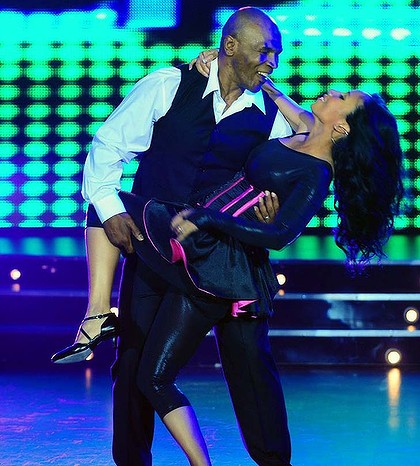
Mike Tyson struts his stuff on the dance floor


He may have once bitten off an opponent's ear, but former boxing champion Mike Tyson is now shaking his hips on a reality television dance show.

Tyson, once the heavyweight world champion, looked like he was having lots of fun as he boogied to the music with his wife Lakiha Spicer on the Argentinian version of Dancing with the Stars, Bailando 2011.

And the audience in the studio appeared to enjoy the salsa routine, cheering and clapping loudly as the boxer once known as the "Baddest Man on the Planet" kissed Spicer at the end of the dance.

Mike Tyson struts his stuff on the dance floor


Busting the moves ... Mike Tyson dances with his wife.

Busting the moves ... Mike Tyson dances with his wife. Photo: AFP PHOTO / Ideas Del Sur

He may have once bitten off an opponent's ear, but former boxing champion Mike Tyson is now shaking his hips on a reality television dance show.

Tyson, once the heavyweight world champion, looked like he was having lots of fun as he boogied to the music with his wife Lakiha Spicer on the Argentinian version of Dancing with the Stars, Bailando 2011.

And the audience in the studio appeared to enjoy the salsa routine, cheering and clapping loudly as the boxer once known as the "Baddest Man on the Planet" kissed Spicer at the end of the dance.


"My wife & I are in Argentina. I'm on Argentina's version of Dancing w/ the Stars tonight," Tyson tweeted yesterday.

The 44-year-old pigeon lover is no stranger to dancing in front of the camera, having taken part in the Italian version of the Dancing with the Stars last year.

Bailando 2011 will showcase the dancing talents of about 30 celebrities, including former Baywatch star Pamela Anderson, Fox News reported.

Source smh


Twitter Delicious Facebook Digg Favorites More